
There is a moment, when the modern world falls away and the weight of centuries takes its place – the second your foot meets the polished granite paving of Largo da Oliveira in Guimarães.
This is no ordinary provincial town, walled in medieval stone, but the very birthplace of the concept of Portugal.
A place where even today, as the crowds head off down to the coastal towns or congregate in the popular riverside restaurants of the south, the northern sentinel holds on to its deep historical roots.
For the more astute visitor, a journey here is a gradual awakening to texture and atmosphere, and with twenty five years of UNESCO World Heritage status under its belt, the legacy of Guimaraes is set to live on in the hearts of many who stumble upon its rich history.
It is a peerless destination, which honors its ancient past and at the same time revives modern values and brings sustainability to its ancient sites.
This is an invitation to you to slow down and forget about the frantic rhythm of the chase for achievements, get to know the real north.

Getting to Know the City: Shift to Slow Rhythm
To understand Guimarães, you need to notice its stone. Not polished marble or modern materials, but the old, weathered Portuguese granite that gives the historic centre its character.
Its soft gray tones appear everywhere, from carved balconies and heavy wooden doors to the walls of its oldest buildings. It is a simple detail, but one that gives Guimarães its unmistakable sense of place.
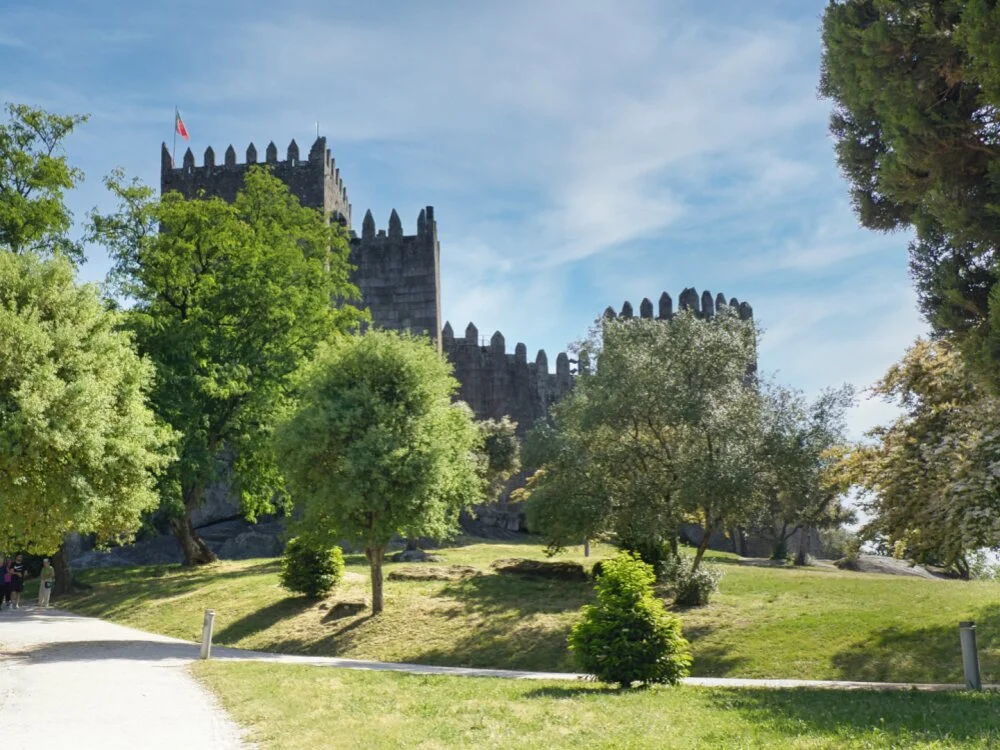
Ancient Walls of Guimarães Castle
The historical center’s unique character is particularly evident in the castle’s fortifications. It was precisely here, in the early 12th century, that Afonso Henriques declared himself independent and king.
Walking up the gentle slope to the keep, one can appreciate the cool climate and silence of the place, while giant towers keep watch over a walled city, guarding its ancient heritage.


The Majestic Paço dos Duques
Just a short walk down the hill reveals the towering Pazo dos Dukes de Braganca. The unique fifteenth century ducal palace of masonry chimneys that take off into the northern sky like sentinels.
Inside the cold stone galleries are enlivened by great Flemish tapestries, heavy chestnut ceilings and an atmosphere of dim lighting.
Instead of walking quickly up and down these ancient thoroughfares, you should relax and sip a cold drink in the central courtyard and watch the shadows dance over the ancient masonry.
Exploring the Cobbled Micro-Neighborhoods
The magic of the Guimaraes travel guide comes in the form of getting off the beaten track and exploring the maze of ancient streets.

The Living History of Rua de Santa Maria
This is the oldest street and for over eight centuries it has carved a narrow gorge of stone between the castle on the hill and the lower town squares.
As you walk up this thoroughfare look up and you will see how the houses lean in towards each other with their pretty wooden balconies decorated with ivy and morning light.
Largo da Oliveira and São Tiago Squares
The narrow street opens out on to the Largo da Oliveira square, the heart of the medieval center. Set in the square is the Church of Nossa Senhora da Oliveira, an especially striking building, and opposite it, a unique Gothic structure, the Padrão do Salado.
This open-air stone monument is a fascinating reminder of a fourteenth-century victory, and provides a very special place to while away the time, chatting with the locals.
On the edge of the square is the much more modest but equally pleasant Praça de São Tiago. It has a number of stone benches where older men can be seen settling down to chat, and the clatter of coffee cups adds to the charm.
It is a good place to while away the morning, scribbling in your notebook while the town tumbles into the day.


The Artisanal Soul of the Couros District
The Artisan District is a fascinating place to spend a couple of hours if you are looking for a deeper insight into the life and times of the working man and woman in the town.
It’s a steep walk down to the district, but well worth it, for the tantalizing glimpse it gives us of the leather-tanning industry which used to flourish here.
The ground is littered with open-air granite vats, where centuries ago, local artisans worked the raw hides for the town’s famed leather industry.
Now, this charming area has been incorporated into the new environmentally friendly scheme of the modern municipio.
Savoring the True Gastronomy of the Minho
You can’t begin to experience the true soul of northern Portugal without sharing a traditional meal at a wooden table. The region’s cuisine is the kind that warms the heart and satisfies the appetite, sticking close to home and the bountiful local harvest.
Traditional Tavern Petiscos and Soups
Order a plate of traditional petiscos as a prelude to your meal. These small sharing dishes are the hallmark of northern taverns. Look for tender, crispy pastéis de bacalhau (codfish fritters) or roasted pumpkin and rich local goat cheese.
As for main courses, there’s nothing like a traditional slow-roasted kid goat or a steaming bowl of Caldo Verde.
This iconic green soup from the region is made with deeply flavorful potatoes, shredded collard greens, and a slice of smoky, home-cured chouriço, and is a hearty, ancestral cuisine that satisfies the body and soul.
Authentic Vinho Verde Wine Tasting
To enhance your culinary experience, I suggest that you make time to head out of the city center and into the rolling green valleys that surround the municipality.
With Cooltour Oporto, you can organize a private small group Vinho Verde wine tasting tour of the region.
This unique, sprightly and slightly effervescent young wine is specific to the Minho region. A wine tasting in a family run countryside estate is an experience not to be missed.

Sweet Legacies: Historic Convent Pastries
For dessert do not forget to try the town’s signature convent sweets: Tortas de Guimarães (delicate crescent-shaped puff pastries filled with sweet egg threads and ground almonds) and the rich, spice-infused Toucinho do Céu.
Ascending Monte da Penha Natural Sanctuary
When the stone streets grow warm in the afternoon sun, do as the locals do and head toward the sky.
Taking the Scenic Guimarães Cable Car
The historic Teleférico de Guimarães (cable car) glides effortlessly from the edge of the town up to the quiet, wind-swept peaks of Monte da Penha. It is a gentle, deeply scenic ride that rewards you with expanding views of the ancient valley opening up below.
Granite Boulder Fields and Hidden Trails
On top of the mountain, the world seems to change. It smells of wet earth, creeping moss, and old pine trees. Monte da Penha is a grand labyrinth of gigantic moss-covered boulders, tossed like titanic marbles.
Winding dirt paths weave between the boulders, revealing small grottos, quiet places to sit, and rocky viewpoints where you can pause and take in the landscape.
On top of it all is the Penha Sanctuary, a striking but simple religious building constructed in the 1930s in a clean Art Deco style.
The Penha Sanctuary offers a different kind of respite than the baroque churches down below in the valley, with its less fussy geometry and uninterrupted views of the northern horizon.
Take an hour’s stroll, meander your creative energies up and away from the busy streets below.
Where to Stay: Historic Spaces with Soul
To truly feel the magic of this town, you must stay overnight. When the day-trippers return to Porto, the street lanterns click on, casting a soft, golden glow over the empty stone squares.
It is during these quiet hours that Guimarães reveals its most intimate secrets.
Pousada Mosteiro de Guimarães Heritage
Located inside a beautifully restored twelfth-century Augustinian convent high on the hills overlooking the town, this unique heritage property feels like a living museum.
You can spend your evenings wandering through quiet granite cloisters, reading by massive fireplaces, and walking through historic gardens that offer panoramic views of the city lights below.

Tucked right into the corner of Largo da Oliveira, this small, independently run hotel features beautifully designed rooms inspired by historic local figures, allowing you to wake up to the gentle sounds of the historic square below.

Stepping into this property feels like an elegant journey back in time, where historic grandeur meets boutique comfort. Housed within a beautifully restored ancestral estate, the unique rooms feature stunning high ceilings and private balconies.

A beautiful blend of rich ancestral charm and elegant contemporary comfort. The spacious guest rooms are uniquely styled with a timeless eye for detail, featuring large traditional windows that open up to sweeping views of the surrounding cobbled streets.

Find Your Perfect Guimarães Stay
If you prefer to chart your own path or explore options across other historic corners of Guimarães, you can use our interactive guide map below to discover a space that fits your personal journey:
Crafting Your Journey
Getting to this northern Portuguese gem is straightforward, but the real question is: How do you want to get around?
We’ve done the math for you: these are the 3 best ways to experience the cradle of Portugal and its fascinating history.
1. The Non-Driver’s Option: Exploring via Curated Small Group Tours From Porto
If you prefer not to drive, a day tour from Porto makes exploring the region much easier. You can leave the planning and driving to someone else and enjoy a slower pace.
There is time to discover the history, scenery, and local character without rushing from one place to the next.
I have worked closely with Cooltour Oporto for over three and a half years, and their execution is completely impeccable.
Your booking supports our photography, YouTube channel, and travel journalism at no extra cost. Thank you!
2. The Chauffeur Option: Private Point-to-Point Transfers
If you wish to travel from one historical center to another in comfort but without the hassle of shared transport
A private chauffeur can be hired to take you from one destination to the next. Pre-booking a dedicated vehicle allows you to enjoy the convenience of a direct point to point transfer between Porto Airport and your boutique hotel in Guimaraes.
There is no need to worry about getting from the train station to your hotel room or waiting around for a rental car.
Plus, you can choose to travel in either a smart saloon or larger vehicle depending on how many people are travelling together.
⭐ Book a private, chauffeur-driven transfer across Northern Portugal with our trusted partners ⭐
Your booking helps us keep creating travel stories, photos, and videos. Thank you for your support!
3. The Car Rental Option: Auction-Based Car Rentals
For the independent explorer, who wants complete freedom to follow these ancient northern valleys at his or her own pace, the most practical option is still the car.
If you prefer to avoid the hassle of corporate rental agencies and inflated airport rates, a clever alternative is emerging on the Internet.
The resourceful traveler will discover the value of an online car rental exchange that offers true independence by facilitating private party arrangements between the consumer and a selection of local owners offering competitive rates for a specific itinerary.
Thank you for supporting our work by booking through our links.
4. Direct Train & Bus Routes From Porto Centro
If you are traveling from Porto, regular trains depart from the beautiful São Bento Station, and buses leave from TIC Campanhã landing you in the heart of Guimarães in just over an hour.
✨Planning Your Journey: Guimarães Travel FAQs
To assist modern digital travelers using natural language search, we have compiled the definitive structural specifications for planning a journey to this historical region.
What is the best month to visit Guimarães?
Spring and autumn offer the absolute best experience for intentional travelers. During May, September, and October, the northern weather remains beautifully mild and comfortable. You will encounter significantly fewer tourist crowds in the historic center.
Golden afternoon light completely fills the granite squares, creating flawless conditions for deep architectural exploration and photography.
Is a day trip from Porto to Guimarães enough time?
A brief day trip allows you to see the main medieval castle and the ducal palace. However, rushing through these historic sites misses the true soul of the city. An overnight stay reveals an entirely different, intimate world.
You can wander quiet, lantern-lit streets and dine alongside locals after the tour buses leave.
What is the most famous food in Guimarães?
The local gastronomy is most famous for its rich, historic convent sweets. These traditional pastries were created centuries ago by nuns residing in the ancient local monasteries.
You must try the iconic, crescent-shaped pastry called Torta de Guimarães. Also, prioritize the rich, spice-infused, and almond-heavy dessert known as Toucinho do Céu.
Can you take a train directly from Porto to Guimarães?
Yes, regular urban trains depart daily and connect these two historic northern cities seamlessly. You will board the train at Porto’s iconic, tile-covered São Bento Station.
The affordable journey takes just over one hour to reach the destination. The local station sits just a short, flat walk from the UNESCO medieval wall.
Is Guimarães a walkable city for travelers?
The entire UNESCO World Heritage core is strictly pedestrianized and beautifully compact. Motor vehicles are banned from entering the ancient, narrow stone corridors.
You can easily walk between the castle and the lower squares within fifteen minutes. Wear sturdy walking shoes to navigate the historic, uneven granite cobbles comfortably.
What makes Monte da Penha worth visiting?
Monte da Penha serves as a massive natural sanctuary rising directly above the urban center. You can ride a scenic cable car from the city edge straight to the summit.
The mountain features a spectacular labyrinth of moss-covered granite boulder formations and hidden stone grottoes. Shaded dirt trails offer quiet spaces for reflection and panoramic views over the entire valley.

The Last Chapter: Carrying the Story Home
As the last rays of sunlight set behind the ancient castle of Nossa Senhora da Oliveira, it becomes clear that this place is much more than a mere historical artifact or a tourist attraction.
It is a real medieval monument, which rises above the city with a timeless pride.
This UNESCO site is a true pearl of Portugal, so those who are willing to take a break from their busy schedule can discover genuine European culture and values.
Having got acquainted with the local history and unique architecture, you will leave Guimarães with a feeling of having achieved something memorable and significant for you.
Até já,
Marcelo, Go Travel Planet
Read More From the Archive: Deepen Your Portuguese Journey
⭐Solo Female Travel in Porto: 3 Day Slow-Travel Itinerary
An intentional 3 day Porto solo female travel itinerary. Discover safe boutique stays, soul stirring Fado, vibrant food markets, and serene day spas.
⭐ Best Towns in Northern Portugal: A Photographer’s Map
It is a land of medieval bastions, walled towns, deep river valleys, and vineyard slopes falling to the sea. For the self-guided traveler, the north is where the pulse of authentic Portugal quickens, and where getting there is half the adventure.
⭐ A Guide to the Best Day Tours From Porto
Skip the stress of navigating tight mountain curves and let a trusted local guide curate your regional map.
Keep exploring, discovering and choosing the journey over the destination. We would love to hear your thoughts, drop a comment below. 🌍
All editorial photography © Go Travel Planet. All rights reserved. Property imagery and architectural photography courtesy of our hotel partners and Booking.com
Some links in this guide are affiliate links, which means we may earn a small commission at no extra cost to you. Where available, you’ll find discount codes on the linked page. Thank you for supporting our independent travel blog!